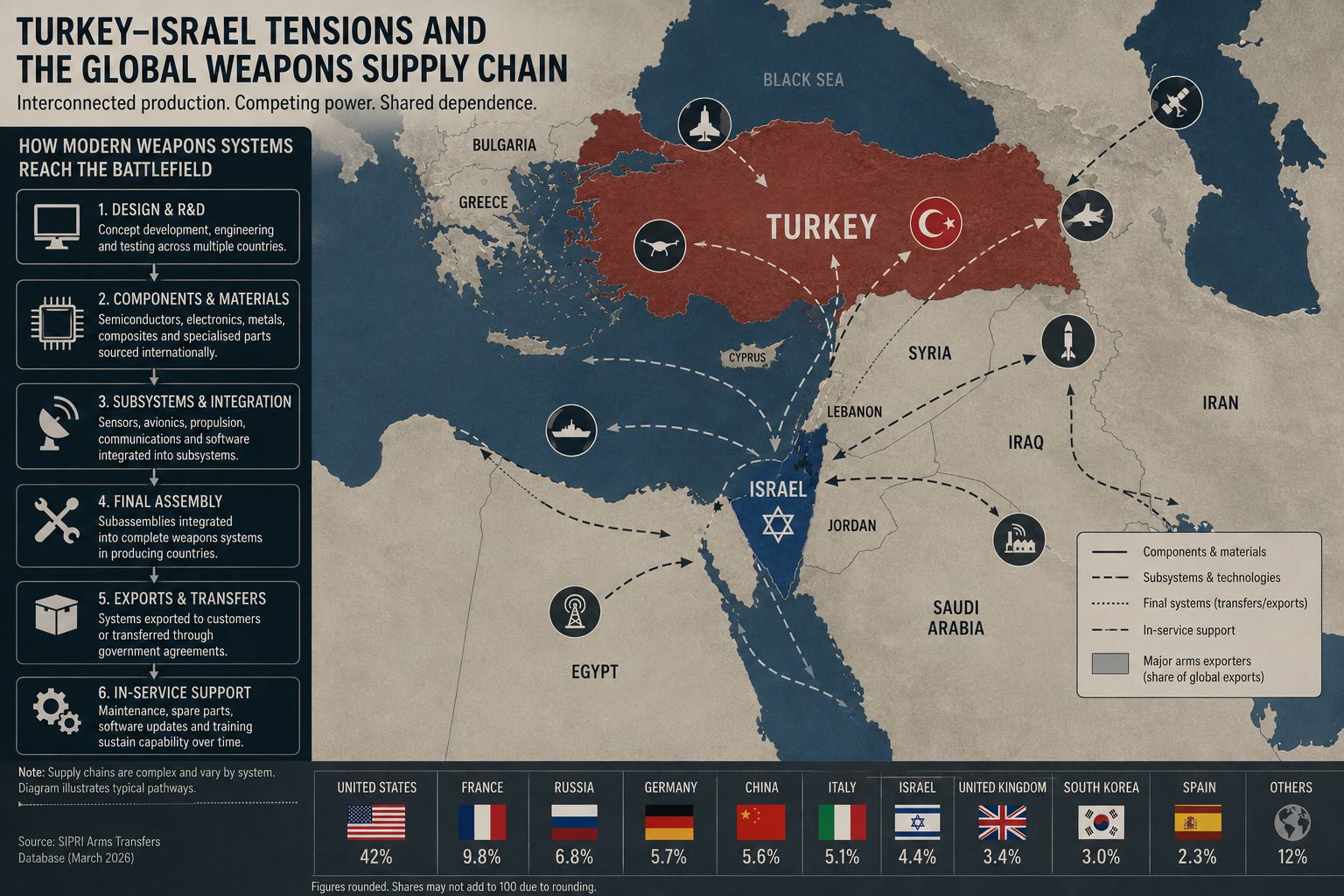
There is increasing evidence that international relations is moving into a new period of sustained ‘hot war’, characterised not only by the return of major interstate conflict but by the possibility of conflict between states whose economic, technological and security relationships remain deeply interconnected. This differs significantly from the bipolar military order of the Cold War. Several decades of globalisation have created production and supply networks extending across states and political alignments, including within industries directly associated with national security. Consequently, while contemporary warfare continues to be organised politically around sovereign states, the industrial system through which those states acquire military power is considerably more international.
The global arms economy illustrates the scale of this development. International transfers of major weapons increased by 9.2 per cent between 2016–20 and 2021–25, the largest increase since 2011–15, while European arms imports increased by 210 per cent. The United States remained the largest international supplier, accounting for 42 per cent of global arms exports during 2021–25 (George et al., 2026). The concentration of the industry is equally important. SIPRI identifies 66 states supplying major weapons during this period, although the largest 25 accounted for 98 per cent of transfers (SIPRI, 2026).
These figures only partially describe the internationalisation of defence production because an exported weapons system is itself the product of a much larger industrial network. Modern aircraft, missiles, drones and air-defence systems depend upon semiconductors, electronics, specialist materials, machine tools, software and manufacturing capabilities that frequently originate in different countries. Even states pursuing explicitly indigenous defence programmes therefore remain connected to international technology and supply networks. The distinction between a national weapons system and an international system of production is consequently less straightforward than the political language surrounding defence procurement often suggests.
This produces a particular problem during periods of conflict. It would be inaccurate to claim that defence companies routinely supply both sides of individual wars, but the industrial and commercial relationships underlying weapons production do not necessarily correspond to the political divisions created by those wars. Weapons transferred during an earlier political relationship remain operational after that relationship changes, while components, licences, subcontracting relationships and dual-use technologies can circulate through considerably more complicated networks. SIPRI itself notes that arms-exporting states are often directly or indirectly connected to the conflicts generating demand and that this can result in weapons continuing to be supplied even where transfers appear inconsistent with declared export policies (SIPRI, 2026).
There is a further dimension to this relationship because contemporary conflicts inevitably become testing environments for military technologies. Weapons can be extensively evaluated before deployment, but combat provides information that simulation cannot fully reproduce because the technology encounters an adversary actively attempting to defeat it. The wars in Ukraine and the Middle East have provided extensive operational evidence concerning drones, counter-drone systems, electronic warfare, missile interception and the vulnerability of established military platforms. This information feeds back into procurement, product development and international sales. The argument is not that wars are initiated to test weapons, but that once they occur they perform this function whether intended or not. For defence producers, combat validates some technological assumptions and disproves others, while battlefield performance can influence the commercial prospects of particular systems. War is therefore simultaneously a geopolitical event and a process through which military technology and the international market supplying it develop.
The emerging confrontation between Turkey and Israel provides an unusually important case through which to examine these issues. Their competing security interests in Syria have moved beyond diplomatic disagreement and increasingly involve questions of military presence and regional power. In August 2026 Israel attacked the Abu al-Duhur airbase in north-western Syria following concerns that Turkish forces could be deployed there. Turkey denied that such a deployment was planned and condemned the attack, while the United States began developing a more formal deconfliction mechanism between Turkey, Israel and Syria because of the possibility that misunderstanding could result in a direct military confrontation (Azhari, 2026). Israeli and Turkish warnings subsequently became more explicit, although both sides continued to indicate an interest in avoiding direct conflict (Reuters, 2026).
Turkey’s position within this emerging confrontation is particularly significant because the development of its defence industry is connected to a much longer concern with military sovereignty. The origins of the modern Turkish defence-industrial project can be traced partly to the Cyprus crises of the 1960s. The 1964 Johnson Letter demonstrated the political limitations that could accompany dependence upon American military equipment, while the experience of the 1974 Cyprus intervention and subsequent United States arms embargo reinforced the vulnerability created by reliance upon external suppliers. Diversification, local production and ultimately the indigenisation of major weapons systems became progressively more important elements of Turkish defence policy (Güvenç, 2026).
The subsequent development of ASELSAN, Turkish Aerospace Industries and, more recently, Turkey’s missile, naval, electronic-warfare and unmanned-systems industries should therefore not be interpreted simply as a feature of Erdoğan-era foreign policy. It reflects a longer attempt to convert formal political sovereignty into greater material military sovereignty. The distinction is important because a state can possess recognised borders, diplomatic representation and legal independence while remaining dependent upon another state for aircraft, communications systems, missiles, software, spare parts or strategically important components. Military dependence can therefore constrain the practical exercise of sovereignty even where formal sovereignty remains unaffected.
This history also helps explain why Turkey creates a particularly difficult problem for the Western security system if its confrontation with Israel continues to develop. Turkey cannot easily be treated as an external actor. It has been a NATO member since 1952, possesses one of the alliance’s largest armed forces, remains deeply connected to European markets and has become an increasingly important producer and exporter of weapons. It is also politically normalised within international affairs in a way that makes the construction of Turkey as an uncomplicated external adversary considerably more difficult. A serious Turkish-Israeli conflict would therefore challenge conventional distinctions between Western allies and external threats, particularly where two militarily important states embedded in Western security relationships developed incompatible understandings of regional security.
There is an obvious neorealist interpretation of this development. Waltz’s Theory of International Politics treats the absence of a superior authority capable of guaranteeing state security as a defining characteristic of international politics. States consequently operate within a self-help system in which capabilities remain important irrespective of alliances or declared intentions (Waltz, 1979). Turkey’s defence-industrial strategy fits this logic reasonably well. NATO membership may substantially increase Turkish security, but it cannot remove the possibility that an ally will restrict access to military technology. The historical experience of sanctions provides direct evidence of this vulnerability, making the development of indigenous military capability a rational response to the structure within which Turkey operates.
Mearsheimer’s offensive realism develops the argument by emphasising uncertainty about intentions and the resulting importance of relative power. Because states cannot know the future intentions of other states, increases in capability can appear threatening even where the state acquiring them considers its objectives defensive (Mearsheimer, 2001). This provides a useful interpretation of the emerging Turkish-Israeli competition in Syria. Ankara may understand a Turkish military presence as consistent with its security interests and its relationship with the Syrian government, while Israel can interpret exactly the same development as an unacceptable alteration in the regional distribution of military power. Israeli action intended to prevent this development then provides Turkey with additional reasons to value autonomous military capability. This resembles the security dilemma identified by Jervis (1978), in which attempts by one state to increase its security reduce the perceived security of another and can generate escalation without either state initially seeking direct conflict.
The renewed relevance of these arguments also returns international relations to the theoretical debate that developed around neorealism during the 1980s. Keohane’s Neorealism and Its Critics brought together Waltz’s structural realism with criticisms developed by writers including Robert Cox, John Ruggie and Richard Ashley (Keohane, 1986). This debate concerned more than whether neorealism adequately explained state behaviour. It also questioned some of the assumptions about states, sovereignty and international order upon which neorealism depended.
Ashley was particularly critical of the treatment of the sovereign state as an already constituted unit from which analysis could begin. In The Poverty of Neorealism, he argued that neorealism transformed historically contingent assumptions concerning states and sovereignty into apparently objective features of international politics. His observation that the state could itself be understood as an “effect of power” (Ashley, 1984, p. 269) is particularly relevant to the contemporary problem. Rather than beginning with sovereign states and examining how an anarchic international structure constrains their behaviour, Ashley’s critique permits the prior question of how those sovereign actors are constituted and reproduced through political, economic and social relationships.
Ashley developed this criticism further in Untying the Sovereign State, challenging the conventional division through which political order is located inside the sovereign state while anarchy is located outside it (Ashley, 1988). This matters considerably in the context of contemporary defence production because military sovereignty is simultaneously being asserted by states and complicated by the transnational relationships through which military capability is produced. Turkey’s indigenous defence programme seeks to increase sovereign freedom of action, but Turkish defence production nevertheless remains connected to international technologies, markets and industrial relationships. The same applies to Israel, European defence producers and the United States. Sovereignty in this context is better understood as involving different degrees and forms of dependence rather than a simple distinction between autonomy and dependence.
The theoretical arguments collected in Neorealism and Its Critics therefore have a relevance that extends beyond their place in the development of International Relations as a discipline. Waltz helps explain why states continue to value autonomous military capability despite extensive economic integration, while Mearsheimer provides an explanation for why changing capabilities can generate competition even where states have previously maintained cooperative relationships. Ashley’s criticism operates at a different level by questioning the sovereign unit upon which these explanations depend. The contemporary defence industry makes this tension particularly visible because military capability remains politically represented as an attribute of sovereign states while being materially produced through networks that frequently extend beyond them.
The possibility of a Turkish-Israeli conflict brings these issues together particularly clearly. It involves two militarily capable states with substantial domestic defence industries, both deeply connected to Western political and security structures, developing increasingly incompatible understandings of the regional balance of power. At the same time, both remain participants in a wider global military-industrial system in which weapons, technologies and components circulate internationally and in which contemporary conflicts provide information that influences the development and marketing of future military systems.
The emerging period of hot war therefore differs from a straightforward return to twentieth-century geopolitics. Neorealist concepts of self-help, relative capability and security competition have regained considerable explanatory importance, but they are operating within a global economic and technological system that complicates the sovereign independence assumed by much realist analysis. The defence industry sits directly within this contradiction. States are attempting to strengthen military sovereignty while the production of military power remains internationally interconnected. In this respect, the theoretical confrontation between neorealism and its critics in the 1980s and 1990s appears less like a settled historical debate than an argument that has acquired renewed relevance under the conditions of twenty-first-century warfare.
References
Ashley, R.K. (1984) ‘The poverty of neorealism’, International Organization, 38(2), pp. 225–286.
Ashley, R.K. (1988) ‘Untying the sovereign state: A double reading of the anarchy problematique’, Millennium: Journal of International Studies, 17(2), pp. 227–262.
Azhari, T. (2026) ‘US working on deconfliction mechanism among Turkey, Israel and Syria, US envoy says’, Reuters, 18 August.
George, M., Djokic, K., Hussain, Z., Wezeman, P.D. and Wezeman, S.T. (2026) Trends in International Arms Transfers, 2025. Stockholm: Stockholm International Peace Research Institute.
Güvenç, S. (2026) ‘Can Turkey’s defense industry deliver strategic autonomy for Ankara?’, Brookings Institution, July.
Jervis, R. (1978) ‘Cooperation under the security dilemma’, World Politics, 30(2), pp. 167–214.
Keohane, R.O. (ed.) (1986) Neorealism and Its Critics. New York: Columbia University Press.
Mearsheimer, J.J. (2001) The Tragedy of Great Power Politics. New York: W.W. Norton.
Reuters (2026) ‘Israel and Turkey step up warnings over Syria after airbase bombing’, Reuters, 20 August.
SIPRI (2026) SIPRI Yearbook 2026: Armaments, Disarmament and International Security. Stockholm: Stockholm International Peace Research Institute.
Waltz, K.N. (1979) Theory of International Politics. Reading, MA: Addison-Wesley.